
4. Heat machines#
4.1. Introduction#
Flow machines transfer energy to a flowing medium or extract it using mechanical energy. Heat machines do the same, only heat is used now. This can be through the addition of heat (e.g. via combustion) or from the withdrawal of heat (e.g. a fridge) or from the transfer of heat (e.g. a heat pump). Our current energy supply is largely based on heat machines such as engines and gas turbines. Energy is getting scarce and more expensive. Existing fossil energy sources must be handled with the utmost care and, where possible, forms of renewable energy must be developed. In this chapter we deal with all processes in which thermal energy plays a role. Two main areas can be distinguished, namely energy storage and transport, and thermodynamics. Energy storage and transport play a particularly important role in the process industry, where substances must be cooled and heated. This is possible in large-scale installations, such as a waste incineration plant where the heat in flue gases is recovered via heat exchangers and is reused for heating houses or greenhouses.
Thermodynamics is used in the design of systems in which cyclic processes take place. Consider, for example, a refrigerator in which the cooling medium is pumped around and absorbs heat in the cooling space and releases heat in the rear radiator. Thermodynamics also plays a major role in drive train technology. Just think of the gasoline engine, the diesel engine, but also the aircraft engine and the rocket engine.
In this chapter you will become acquainted with some principles of heat storage and transport and with circuit processes in thermodynamics.
4.2. Storage of heat#
When we add or remove heat from an object, the heat content of that object changes.
If we assume that the object consists of a solid or a liquid, the following can happen:
A phase change occurs; the solid melts or the liquid evaporates. In either case, the temperature remains unchanged, or:
No phase transition occurs; the temperature of the object then increases or decreases.
In the latter case, the following applies to the temperature change:
In which:
\(\Delta Q\) is the added or removed heat in [J],
\(m\) is the mass of the object in [kg],
\(c\) is the specific heat capacity in [J kg\(^{-1}\) K\(^{-1}\)] or [J kg\(^{-1}\) C\(^{-1}\)] and
\(\Delta T\) is the temperature change in [K] or [°C]
Instead of using the specific heat capacity \(c\), the heat capacity \(C\) of an object is also often used. Especially if the object consists of different materials. The heat capacity of an object determines how much energy must be supplied for 1 degree temperature rise. In equation form:
The heat capacity of one kilogram of water is equal to: \(C_1\) kilogram water = \(m \cdot c_{water} = 1 \cdot 4180 = 4180\ [\textrm{J/K}]\)
Heat storage tank
We use heat storage tanks to store excess heat that we can use later. We approach the storage tanks as cylindrical (see Fig. 4.1). The following applies to the dimensions of the storage tanks: h = 5.0 m; R = 2.0 m and d = 3.0 cm. The storage tanks are made of aluminum. Furthermore, the following is given: \(c_{\textrm{aluminium}} = 880 \quad \textrm{[J/kgK]}\), \(c_\textrm{water} = 4180 \quad \textrm{[J/kgK]}\).
For safety reasons, the temperature of the vessel must remain between 20 °C and 55 °C. What is the maximum amount of heat that can be stored in the vessel? Disregard heat losses to the outside world or assume that the storage tank is perfectly insulated.
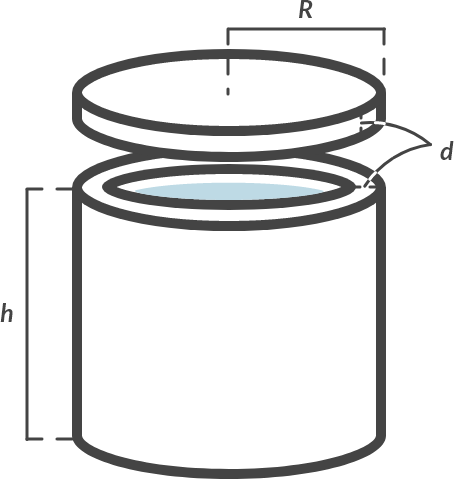
Fig. 4.1 (a) Heat storage tanks (b) schematic representation of the storage tank with dimensions.#
The heat capacity of the tanks is equal to the heat capacity of the water plus the heat capacity of the tank wall:
You can therefore store in a tank:
Note
The contribution of the aluminum tank to the total heat capacity is low, namely 2.5%.
This is on the one hand because the mass of the aluminum casing is much less than that of the water.
Moreover, the specific heat of that aluminum is also much less than that of the water.
4.3. Heat transfer#
There are three basic mechanisms on which heat can be transferred, namely conduction, flow (convection) and radiation.
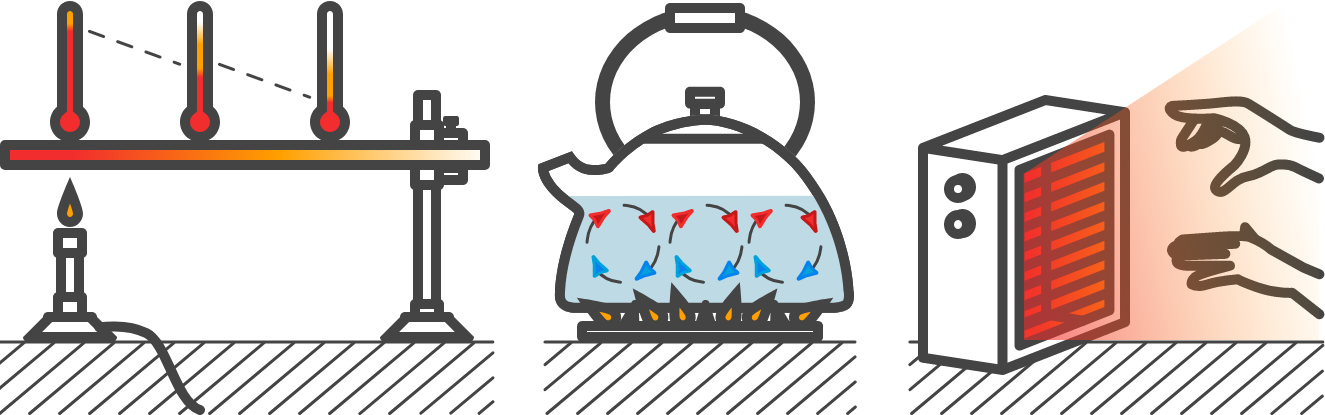
Fig. 4.2 (a) Conduction, (b) convection, (c) radiation.#
If you put a metal spoon in a pan filled with water, the whole spoon will become warm at some point. The heat is transported through the spoon through conduction. If you hold your hand next to the pan you will feel heat radiation. And if you keep your hand above the pan, you will feel heat flow through the rising vapors.
4.3.1. Heat flow by conduction#
If there is a temperature difference over a medium, the heat will flow from the area with the higher temperature to that with a lower temperature. In the context of this course, we only consider 1-dimensional heat flow, so only in the x direction, as displayed in Fig. 4.3
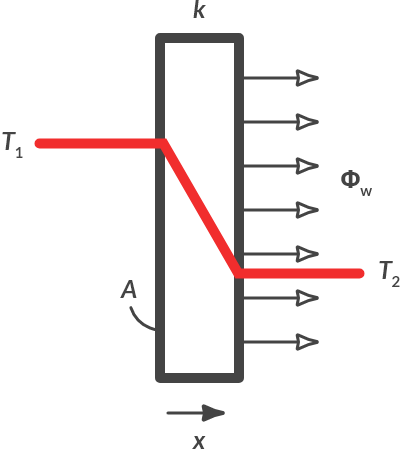
Fig. 4.3 Heat flow by conduction.#
The heat flow through a medium is mathematically described by Fourier’s law:
In which:
\(\phi_w\) is the heat flow in [W],
\(\frac{dT}{dx}\) is the temperature gradient in the medium [K/m] or in [°C/m],
\(A\) is the surface through which the heat flows in [m\(^2\)] and
\(k\) the material-dependent thermal conductivity coefficient in [W/mK].
The minus sign indicates that the heat flow is directed from a high to a lower temperature. If the temperature decreases in the positive x direction, as is the case in Fig. 4.3, the temperature gradient dT/dx is negative and the heat flow (in the positive x direction) is positive.
The thermal conductivity coefficient \(k\) depends on the material. A good conductive material, such as silver or copper, has a high thermal conductivity. A poorly conductive (well-insulated) material, such as glass or air, has a low thermal conductivity. Below in Table 4.1 you can see several thermal conductivity coefficients \(k\) of common materials.
Material |
\(k\) [W/mK] |
|---|---|
Silver (pure) |
410 |
Copper (pure) |
385 |
Aluminum (pure) |
202 |
Nickel (pure) |
93 |
Iron (pure) |
73 |
Steel 1% C |
43 |
Lead (pure) |
35 |
Oak |
0.17 |
Windows glass |
0.78 |
Glass wool |
0.038 |
Water |
0.556 |
Air |
0.024 |
Carbon dioxide |
0.0146 |
Insulation heat storage tank
We look again at the heat storage tank of Example 1. In that example, we have neglected heat loss to the environment. Now assume that there is only heat loss due to conduction. The water in the storage tank has a temperature of 55 \(°C\). The outside temperature is \(20 °C\). We assume that the heat can flow through all wall parts of the storage tank and that the temperature of the water in the tank is homogeneous. How large is the heat loss? Which material would be better suited for insulation?
Solution
Over the wall of the storage tank there is a temperature difference of \(20 °C - 55 °C = -35 °C\). (Where the positive x direction is outwards.) The temperature decreases linearly, the gradient is:
Furthermore, it is known that the storage tank is made of aluminum, k = 202 W/mK. The surface through which the heat flows is:
Therefore, the heat flow from the storage vessel to the outside (the heat loss) is equal to:
In order to keep the contents of the vessel at \(55 °C\), a heating system must supply approximately 2070 kW of heat!
4.3.2. Heat transfer by radiation#
Objects that have heat will radiate this heat. This is done with electromagnetic waves. Until certain temperatures, these waves are not visible to the naked eye. With infrared cameras you can visualize that heat. Such cameras are used, among other things, in night vision equipment.
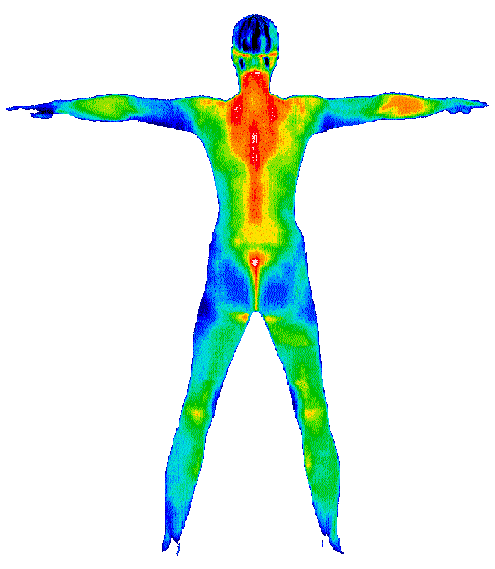
Fig. 4.4 Infrared image showing the temperature distribution of a human.#
If an object becomes warm enough, it will also emit visible light. Just think of glowing steel or the glowing spiral in a radiant stove or toaster.
The amount of emitted radiation can be calculated with:
In which:
\(\phi_w\) is the heat flow in [W],
\(A\) is the surface of the radiating object in [\(m^2\)],
\(\sigma_z\) a proportionality constant, always equal to \(56.7 \cdot 10^{-9} \quad [\textrm{W/m}^2 \textrm{K}^4]\) (=Stefan-Boltzmann’s constant)
\(T\) is the absolute temperature of the radiating object, so always in [K],
\(\epsilon\) is the absorption or emission factor of the surface, depending on the color and surface properties.
Material |
Emission factor \(\epsilon\) |
|---|---|
Coppwe oxide |
0.74 |
Aluminum oxide |
0.80 |
Paper |
0.90 |
Glass |
0.92 |
Wet ice |
0.95 |
Exactly the same relationship applies to the amount of radiation that a small object absorbs, with the difference that T is then the temperature of the environment. If the object (indicated by index 1) is small relative to the environment (index 2), the net heat transfer from the object to the environment can be described as:
In which \(A_1 \sigma_z \epsilon_1 T_1^4\) is the amount of radiation the object emits and \(A_1 \sigma_z \epsilon_1 T_2^4\) the amount of radiation the object absorbs.
Solar collector
In 2001 there were 15,000 households in the Netherlands that used solar collectors for obtaining hot water. The solar collectors collect solar radiation and give heat to water that flows under the collectors. Around noon on an average spring day, such a collector absorbs \(1000 W/m^2\) of solar energy.
The solar collector has a temperature of \(60\) °C. Furthermore, it is stated that the emission factor \(\epsilon\) of the solar collector is 0.90 and that the area \(A\) of the solar collector is \(3.0 m^2\). The outside temperature is \(30 °C\).
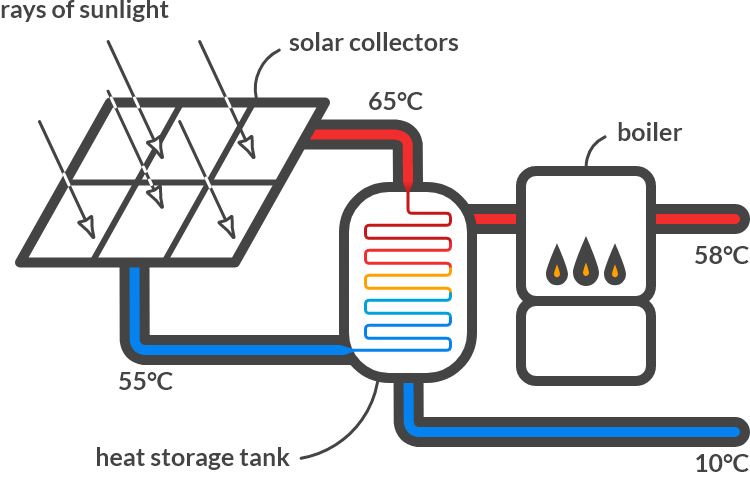
Fig. 4.5 (a) Solar collector (source: Navem), (b) Schematic representation of the solar water heater.#
Which forms of heat transfer play a role in the solar collector?
Solution
The solar collector is warmer than the environment. The solar collector absorbs heat by radiation from the sun. The collector loses heat to the environment through radiation and via conduction and convection to the colder (flowing) ambient air. The collector also releases heat via conduction and convection to the colder water that flows through the collector.
Calculate the amount of heat that the solar water heater loses via radiation to its environment? If we neglect other losses, how much heat is left to heat the water?
Solution
The collector (\(60 °C\)) emits heat through radiation, the size of:
The solar collector also absorbs heat from the environment (\(30 °C\)) via radiation, the size of:
The collector absorbs \(\phi_{w,z} = AI = 3.0 [\textrm{m}^2] \cdot 1000\ [\textrm{W/m}^2] = 3000 \cdot 10^3 \textrm{ [W]}\) from the rays of the sun.
The solar collector therefore has \(3000 - 1882 + 1290 = 2408 \textrm{ [W]}\) of net radiant heat to heat the water.
4.3.3. Heat flow by convection#
If a medium is stationary and there is a temperature difference over that layer, then there is conduction. Due to conduction, heat passes from the high to the low temperature. The temperature is linear over the medium, the temperature gradient is constant. This is shown in Fig. 4.3. If the medium flows at a certain speed, the temperature trend is different, see Fig. 4.6 We are talking about flow, or convection.
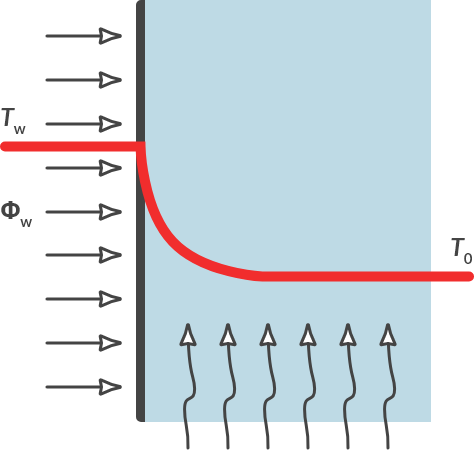
Fig. 4.6 Heat flow by convection in flowing air.#
With gaseous and liquid media (fluids), there is usually convection. If the flow is not imposed (by a pump or the wind, for example) spontaneous flow often arises due to the temperature difference. An example of this spontaneous flow is shown in Fig. 4.2(b). Initially, the water stopped in the kettle. Due to the temperature difference, the warmer water flows up and the colder water flows down.
Calculating convection is a lot more complicated than calculating conduction. The exact course of the temperature gradient is not considered. For the situation in Fig. 4.6, where a hot plate gives off heat to a flowing liquid or gaseous medium, the heat flow can be calculated with:
In which:
\(\phi_w\) is the heat flow in [W],
\(A\) is the surface through which the heat flows in [m\(^2\)],
\(h\) is the heat transfer coefficient [W/m\(^2\)K] and
\(T_w-T_0\) the temperature difference over the flowing medium [K] of [\(° \textrm{C}\)].
The heat transfer coefficient \(h\) depends on the medium, but also on the flow velocity of the medium, the direction of flow and the type of flow (turbulent or laminar). The values of \(h\) are determined by means of experiments. The value of \(h\) will be given per situation within the framework of this course.
Flowing air can dissipate more heat than stationary air.
What can you say about the relationship between \(h_{\text{air}}\) and \(k_{\text{air}}\) ?
4.4. Energy conversion, heat and efficiency#
Many processes are conceivable that add or remove heat to a system. In the previous section we looked at the basic mechanisms on which heat can be transported. In this section we consider the process and its return. We define the efficiency of a heating or cooling process as follows:
Hotplate
A pan with 2.0 liters of water is standing on a hotplate. At t = 0 the water has a temperature of \(20 °C\). The hotplate has an electrical capacity of 1000 W. The efficiency of the hotplate is 80%. The water must be heated from \(20 °C\) to \(70 °C\). How long is the warm-up time? Neglect the heat capacity of the pan. (Why is that allowed?)
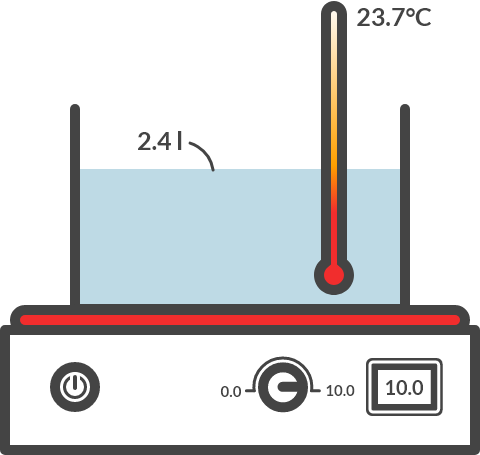
Fig. 4.7 Hotplate heats pan with water.#
The amount of heat supplied to the water is per second:
The increase in temperature per second is equal to:
The warm-up time is then equal to: \(\Delta t_{\textrm{warm-up}} = \frac{70-20}{0.096} = 5.2 \cdot 10^2 \quad \textrm{[s]}\)
Note
Note the difference between the symbols: \(t\) for time and \(T\) for temperature.
Heat exchanger
In a gas water heater water is heated by flames. The cold water flows through the tubes and is heated at the exit by the heat supplied from the flames. It is stated that the combustion yields 45 kW. The heat transfer efficiency on the flowing water is 75%.
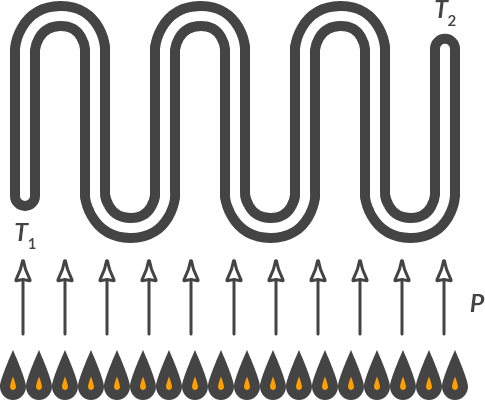
Fig. 4.8 Heat exchanger with heater flames.#
Which heat transfer mechanisms play a role here?
Solution
There is radiation: the tubes absorb heat by radiation from the flames. There is conduction: the pipes conduct the heat to the water. And there is convection: the hot combustion gases flow past the hot pipes and the hot pipes release heat to the flowing water.
How much heat is supplied to the flowing water per second?
Solution
\(0.75 \cdot 45 \textrm{[kJ]} = 33.75 \textrm{[kJ]}\) is supplied to the water every second.
0.1 kg of cold water is supplied per second and 0.1 kg of heated water leaves the system. In other words: the mass flow rate is 0.1 kg/s. The total capacity of the heat exchanger pipe is 5 liters. Initially the water is 10 °C. What is the final temperature? What assumptions do you make to solve this easily?
Solution
A filled heat exchanger contains 5 kg of water. The total content of the heat exchanger heats up every second with:
After entry the water stays in the heat exchanger for \(m/\dot{m} = 5/0.1 = 50\) seconds. The final temperature of the water is therefore equal to:
Note
If you want more water per second (you increase the mass flow) and you do not increase the capacity of the burner, the temperature of the outgoing water drops! As soon as that heat exchanger rises in temperature, it will radiate heat itself to its (albeit also warm) environment!
4.5. Thermodynamics#
4.5.1. Ideal gas law#
For an ideal gas, the gas law can be deduced by conducting three experiments.
In the first experiment, a constant amount of gas in a cylinder is compressed by a pressure, while the temperature remains constant: isothermal compression.
In the second experiment, a constant amount of gas is heated in a cylinder while the pressure is kept constant: isobaric expansion.
In the third experiment, a constant amount of gas is heated in a cylinder, while the volume is kept constant: isochoric heating.
The three experiments are shown schematically in Fig. 4.9.
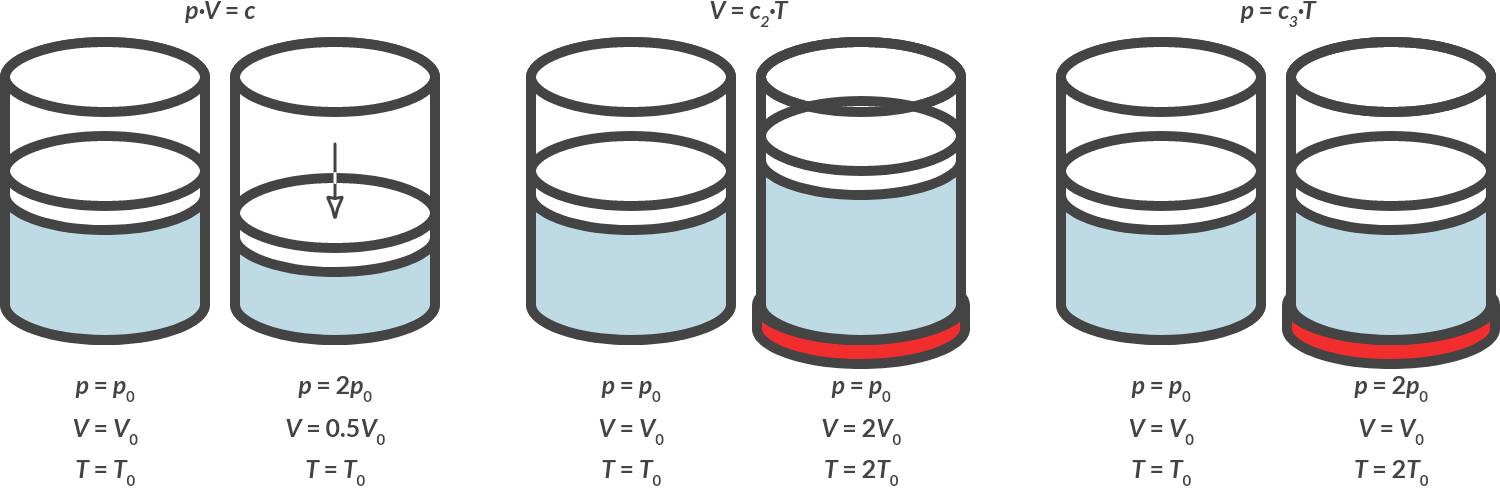
Fig. 4.9 Isothermal compression, isobaric heating, isochoric heating.#
From these three experiments, the following applies for each gas:
4.5.2. p-V-diagram#
In thermodynamics, it is common to display the state of the gas in a p-V diagram. In Fig. 4.10 the experiments of Fig. 4.9 are plotted in p-V diagrams. You see an isothermal (constant temperature), an isobaric (constant pressure) and an isochoric (constant volume) process, respectively.
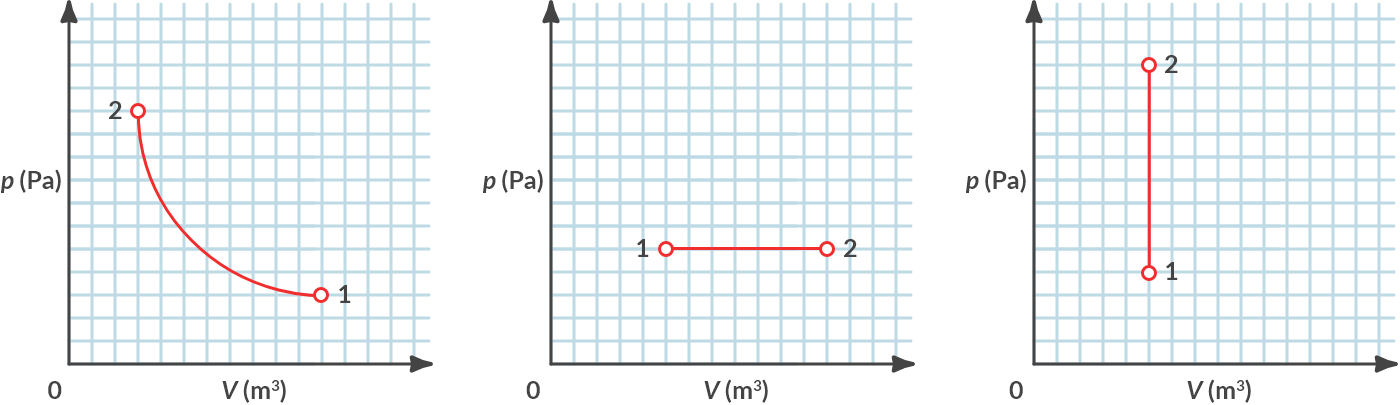
Fig. 4.10 (a) Isothermal, (b) isobaric, (c) isochoric.#
Note
By which relationships, which can be derived from (4.17), are these three graphs described?
4.6. Cyclic process#
A cyclic process is a process that consists of several process steps. For those process steps, it applies that after performing the final step, the state of the gas is again identical to the initial state. This applies, for example, to the processes of a cylinder of a (car) engine in which one has to deal with a compression step, a combustion step, an expansion step and an exchange change step. But a refrigerator also works that way; or a heat pump or a gas turbine. With a gas, the condition is determined by its temperature, its pressure and its volume. In a p-V diagram, therefore, a recycle process always forms a closed form.
Recycle process
A simple recycle process is shown in Fig. 4.11

Fig. 4.11 Cyclic process.#
At the end of process 6, the state is identical to start state 1: this is called a cyclic process. The following happens during the circular process:
Process/state |
Description |
|---|---|
1 |
The piston lies quietly on the locking pins. |
1 \(\to\) 2 |
A box is placed on the piston. The piston rests on the locking pins. |
2 \(\to\) 3 |
Heat is supplied. The pressure increases until the gas pressure overcomes the load. The volume remains the same. |
3 \(\to\) 4 |
Heat is supplied. The pressure no longer increases, but the gas expands until the piston just presses against the upper locking pins. |
4 \(\to\) 5 |
The crate is taken away. The piston presses against the locking pins from below. |
5 \(\to\) 6 |
Heat is extracted from the gas. The pressure decreases until the pressure is just equal to the outside air pressure plus the pressure of the weight of the piston. |
6 \(\to\) 1 |
Heat is further extracted from the gas. The pressure no longer decreases, but the volume of the gas decreases. If the piston rests correctly on the locking pins, the heat dissipation will be stopped. |
If we plot this cycle process in a p-V diagram we get:
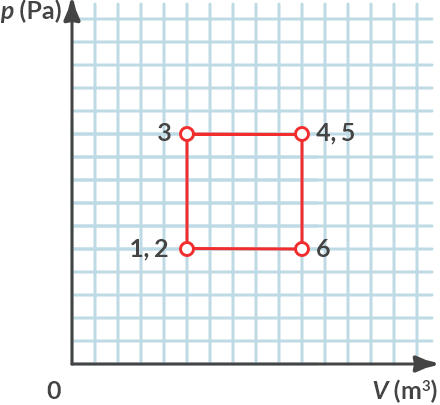
Fig. 4.12 \(p-V\)-diagram of the recycle process.#
4.6.1. Work of a gas#
In the cyclic process of Example 6 work is done in \(3\to4\). After all, a (constant) force is exerted over a distance traveled. This work is performed by the gas. The gas performs the following work:
If the force is not constant during the displacement, or if the pressure is not constant during the expansion of the gas, then the following applies to the work of the gas:
In a p-V diagram, this is equal to the area under the graph. If the volume of the gas increases, the gas performs positive work, if the volume decreases (then the gas counteracts), the gas performs negative work.
Work in a cyclic process
On which routes is work carried out by the gas in the cycle process of Example 6?
Is that negative or positive work?
Solution
The gas only performs work if it changes its volume. From \(3 \to 4\) the gas performs positive work (expansion), from \(5 \to 6\) the gas performs negative work (compression).
Work in a cyclic process (2)
Calculate the work done by the gas in the cycle of Fig. 4.3 (a). What is the net work per cycle that the gas delivers?
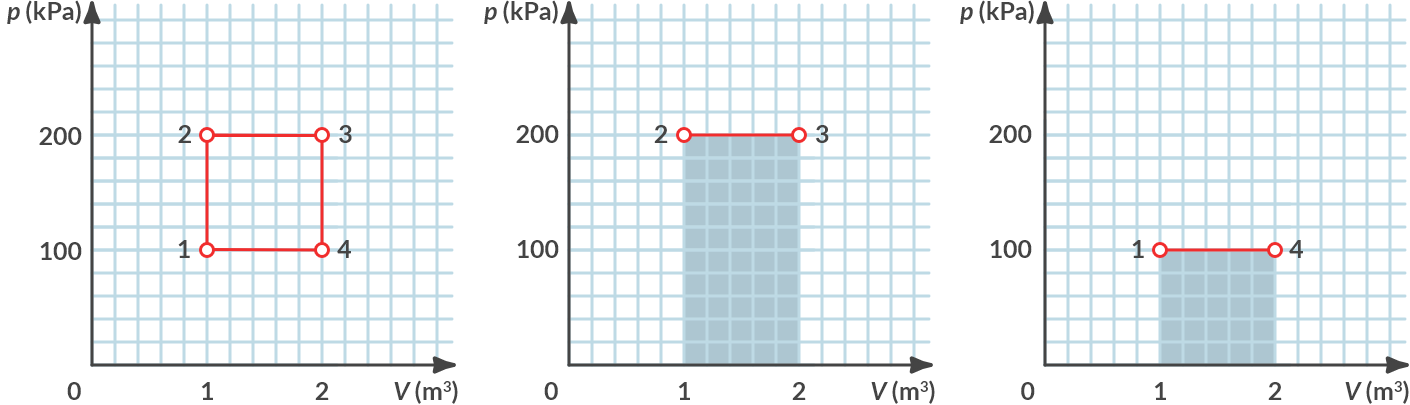
Fig. 4.13 (a) Cyclic process, (b) performed positive work, (c) performed negative work.#
Solution
From 2 to 3, the gas itself delivers positive work by expanding with the size of:
\(W_{2 \to 3} = p \cdot \Delta V = 200 \textrm{[kPa]} \cdot (2-1) [\textrm{m}^3]= 200 \textrm{[kJ]}\)
From 4 to 1 the gas performs negative work because it is compressed by the size of:
\(W_{2 \to 3} = 100 \textrm{ [kPa]} \cdot (1-2) [\textrm{m}^3]= -100 \textrm{[kJ]}\)
From 1 to 2 and from 3 to 4 are isochoric steps, the volume does not change, and the gas does not perform any work.
Overall, the gas performs in this cycle \(W_{\textrm{cycle}} = 200 \textrm{[kJ]} - 100 \textrm{[kJ]} = 100 \textrm{[kJ]}\) net positive work.
In the case of heat machines, heat dQ is added (or extracted) from the device to the gas (or liquid) that flows through it. This heat is used on the one hand by the machine to perform work on the gas, but part of the heat is used to heat the gas, whereby the internal energy of the gas increases \(\textrm{dU} = m \cdot c_V \cdot \textrm{dT}\), where dT is the temperature increase and \(c_V\) the specific heat at constant volume. This is the specific heat of a gas if the gas is kept in a constant volume. The following applies as result of energy conservation
dQ = dW + dU.
This comparison is known as the first law of thermodynamics. Not all heat dQ that is added or withdrawn from the system can be efficiently converted into work dW.
4.7. To be continued#
What lies ahead
In this chapter you have become acquainted with energy storage and energy transport. You can use the theory that you have learned here to make an initial estimate of heat storage and heat transfer processes. Heat transfer via convection has not yet been discussed in detail but will be discussed extensively in the remainder of the curriculum. Convection plays an important role in the development of heat exchangers, for example. All kinds of design choices (material, pipe diameter, pipe roughness) all influence the heat transfer. These design choices also influence the choice of pumps that the media must pump through the heat exchanger. The field of energy technology is closely linked to the field of process engineering constructions (liquids and flow) and combustion technology.